Operational consistency
Every location executes the same governed standard—not tribal memory.

Recipe, Formula & Culinary Intelligence Center
MiseCentral is designed to treat recipes and formulas as the operational language of your organization inside an Adaptive Operating System for Hospitality—governing consistency, production, purchasing, inventory, quality, food safety, nutrition, allergens, costing, traceability, labor expectations, and executive reporting. This is an enterprise evaluation page—not recipe software, not a cookbook, and not a digital recipe database.
Illustrative capability only. Recipe governance, costing, yield, and culinary intelligence concepts shown are architectural and future platform capabilities. MiseCentral does not replace dedicated recipe management applications. No operational or financial outcomes are guaranteed.
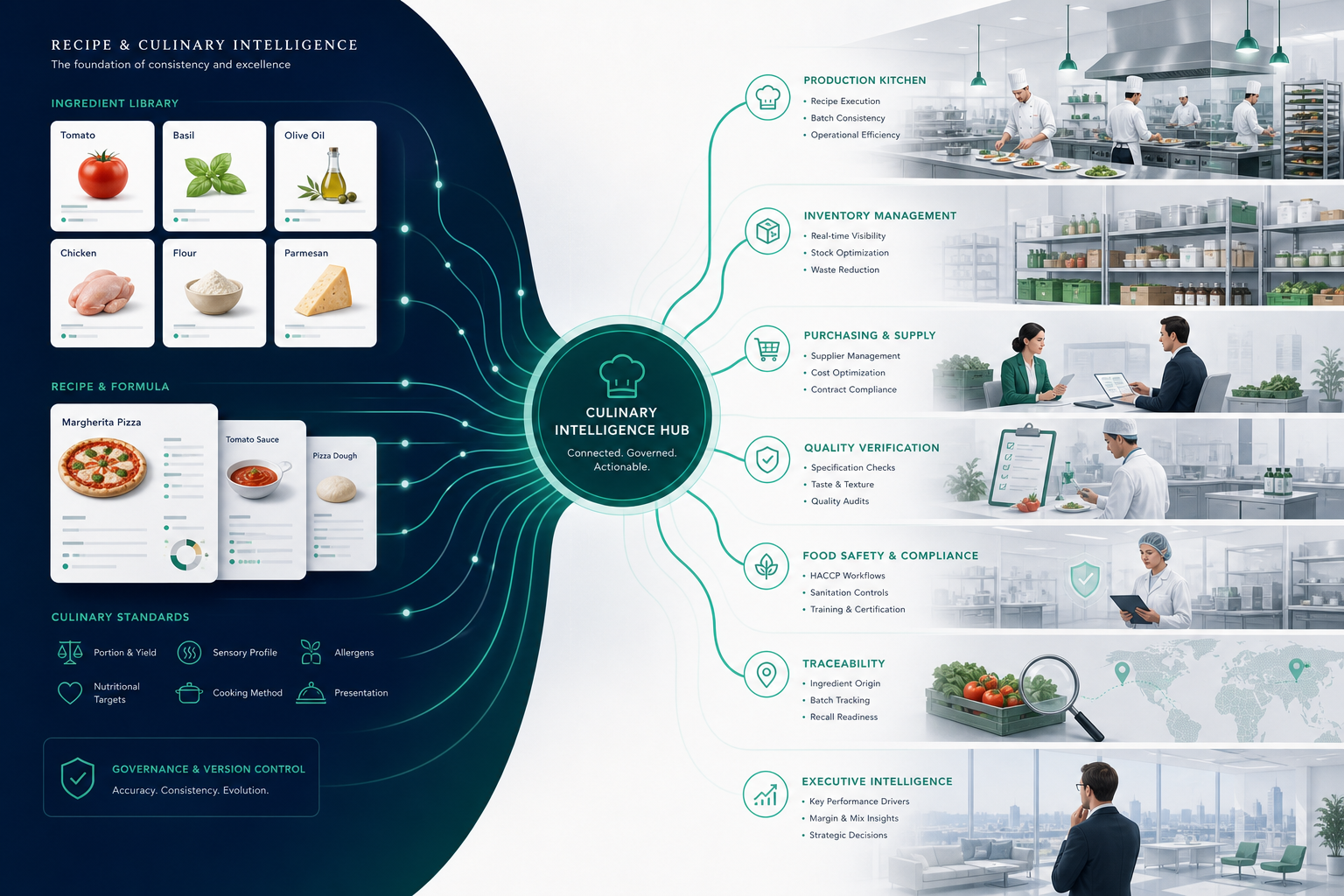
Recipe Philosophy
Governed recipes and formulas become living operational knowledge rather than isolated documents scattered across binders, drives, and spreadsheets.
Every location executes the same governed standard—not tribal memory.
Recipes drive what runs on the line. See Production Operations.
Ingredients and yields define what must be on hand. See Inventory.
Approved recipes inform what to buy. See Purchasing.
Specifications and release context tie to governed recipes. See Quality.
Allergens, holding, and process standards live with the recipe. See Food Safety.
Nutrition references associated with recipes—reference context, not a labeling system.
Allergen context that supports food safety and guest communication programs.
Theoretical food cost and margin awareness from governed ingredient context.
Which recipe version ran with which lots. See Traceability.
Prep and production standards inform labor planning. See Labor Planning.
Recipe performance feeds Business Review and Continuous Improvement.
Recipe Lifecycle
Structured recipe and formula onboarding is available. Imported recipes and formulas remain draft until a person explicitly advances them. This page illustrates the governed path—it is not the live workspace.
Recipe & Formula Framework
Future capability architecture—nothing below is implied as already implemented.
Kitchen and service recipes with portions, steps, and yield targets.
Manufacturing and commissary formulas with batch-scale context.
Governed ingredient lists tied to purchasing and inventory context.
Approved substitutions with operational and allergen implications.
Expected yield defined with each recipe or formula.
Scale recipes and formulas to batch size—architecture intent.
Consistent portion definitions for service and packaging.
Nutrition references associated with recipes—evaluation context only.
Allergen context that supports food safety programs.
Durable history of recipe and formula changes over time.
Roadmap Approval paths before operational release.
How prep should be executed—operational standards.
Pack and label standards tied to finished product context.
Hold times and temperatures for food safety alignment.
Shelf-life context for finished and in-process items.
Brand and culinary standards that define operational consistency.
Recipe Governance
Future governance for version history, approvals, and multi-location consistency. Not document management. Not a digital cookbook.
Which version was active for a given production run or service period.
Roadmap Governed approval before recipes enter operational use.
Clear separation between work-in-progress and operational truth.
Roadmap Structured review before version release.
One governed standard across locations and brands.
Approved regional differences within brand governance.
Culinary and operational brand standards enforced through recipes.
Same recipe version executed consistently across the network.
Costing & Yield Intelligence
Future architecture for ingredient costs, yield calculations, and executive visibility. Illustrative only—no financial guarantees or live costing engine on this site.
Cost context tied to governed ingredient lists—architecture intent.
Expected cost from recipe standards—not a substitute for accounting systems.
Expected yield defined with recipes and compared to actual performance.
Cost and yield context when recipes scale to batch size.
Unit and measure conversions tied to operational standards.
How waste and shrink affect theoretical vs actual performance.
Margin context for menu and product evaluation—not financial advice.
What recipes require informs purchasing conversations. See Purchasing.
Ingredient depletion tied to governed recipes. See Inventory.
Recipe cost and yield patterns in Business Review context.
Company Brain & Culinary Intelligence
Company Brain may eventually surface culinary and operational observations from governed recipe history. Company Brain recommends. Chefs and operators remain responsible.
Illustrative observation when the same recipe changes often without governance.
Illustrative observation when actual yield drifts from governed targets.
Illustrative observation when waste concentrates on specific recipes or steps.
Illustrative observation when unapproved substitutions become routine.
Illustrative observation when ingredient cost or availability shifts affect margin.
Illustrative observation when prep labor exceeds planning assumptions.
Illustrative observation when certain recipes constrain throughput.
Illustrative recommendation to review batch scaling—chefs decide.
Illustrative observation when quality signals correlate with recipe versions.
Illustrative observation when recipe refinement opportunities emerge from patterns.
Company Brain recommends. Chefs and operators remain responsible. No autonomous recipe changes. No automatic menu or formula updates. Learn more in Company Brain.
Operational Evidence Integration
Recipe governance depends on the Operational Evidence Center. Future organization of the records below—architecture only.
Approval records when recipes enter operational use.
Revision history with who changed what and when.
Sensory evaluation context during development and testing.
Quality notes tied to recipe versions and production runs.
Roadmap Visual evidence for plating, packaging, or finished product standards.
Roadmap Method videos for training and standardization context.
Specs, COAs, and reference documents linked to recipes.
Allergen review evidence associated with recipe releases.
Nutrition reference documentation tied to governed recipes.
Yield test results that inform governed yield targets.
Evidence that a recipe version was validated in production context.
Industry Examples
Illustrative examples only. Recipe context differs by industry while remaining on one platform.
Plated items, prep recipes, and batch sauces—consistent execution across shifts and locations.
Outlet kitchens, banquets, and room service governed by the same culinary standards.
Event-scale recipes with yield, allergen, and holding standards for off-site service.
Manufacturing formulas with batch scaling, packaging specs, and release context. See Production Operations.
Prepared items and grab-and-go recipes with portion, shelf-life, and label context.
Commissary and co-packer formulas with traceability and quality alignment for outbound product.
FAQ
No. This page describes future governed recipe and formula architecture inside the Adaptive Operating System—not a standalone recipe application, cookbook, or digital recipe database on this marketing site.
Governed recipes and formulas are designed to drive production runs, batch scaling, and yield verification. See Production Operations for the production execution context.
By design, allergen and nutrition references can be associated with governed recipes to support food safety and operational programs. MiseCentral is not a nutrition labeling or regulatory compliance system. See Food Safety.
No. Theoretical food cost and yield context support operational conversations. Financial systems of record identified in your Enterprise Technology Profile may remain authoritative for journals and valuation.
No. Company Brain may surface observations and recommendations about yield, waste, substitutions, and consistency. Chefs and operators remain responsible. No autonomous recipe changes.
Recipe version context ties to production genealogy—which formula ran, with which ingredients and lots. See Traceability and Inventory.
Governed recipes, allergen evidence, and approval history support inspection and audit conversations. See Inspection Readiness. MiseCentral does not guarantee inspection outcomes.
Implementation identifies current recipe sources, migration paths, and governance standards through the Enterprise Technology Profile. See Implementation and Integrations.
Talk with sales about recipe and culinary intelligence architecture across Production Operations, Inventory, Purchasing, Quality, Traceability, Food Safety, Operational Evidence, Inspection Readiness, Labor Planning, Training, Maintenance, Technology Profile, Platform, Integrations, Implementation, Resources, Support, Pricing, ROI, and Contact Sales.