MiseCentral
Adaptive Operating System
- Recipes
- Production
- Inventory
- Purchasing
- Quality
- Traceability
- Operational Evidence
- Inspection Readiness
- Maintenance
- Training
- Labor Planning
- Business Review
- Company Brain
- Reporting

Developer & Platform Center
MiseCentral is API-first and event-driven—designed so recipes, production, inventory, quality, and reporting remain governed, auditable, and extensible across your enterprise stack. This is a technical evaluation surface—not developer documentation, not an API reference, and not a self-serve SDK portal.
Platform Philosophy
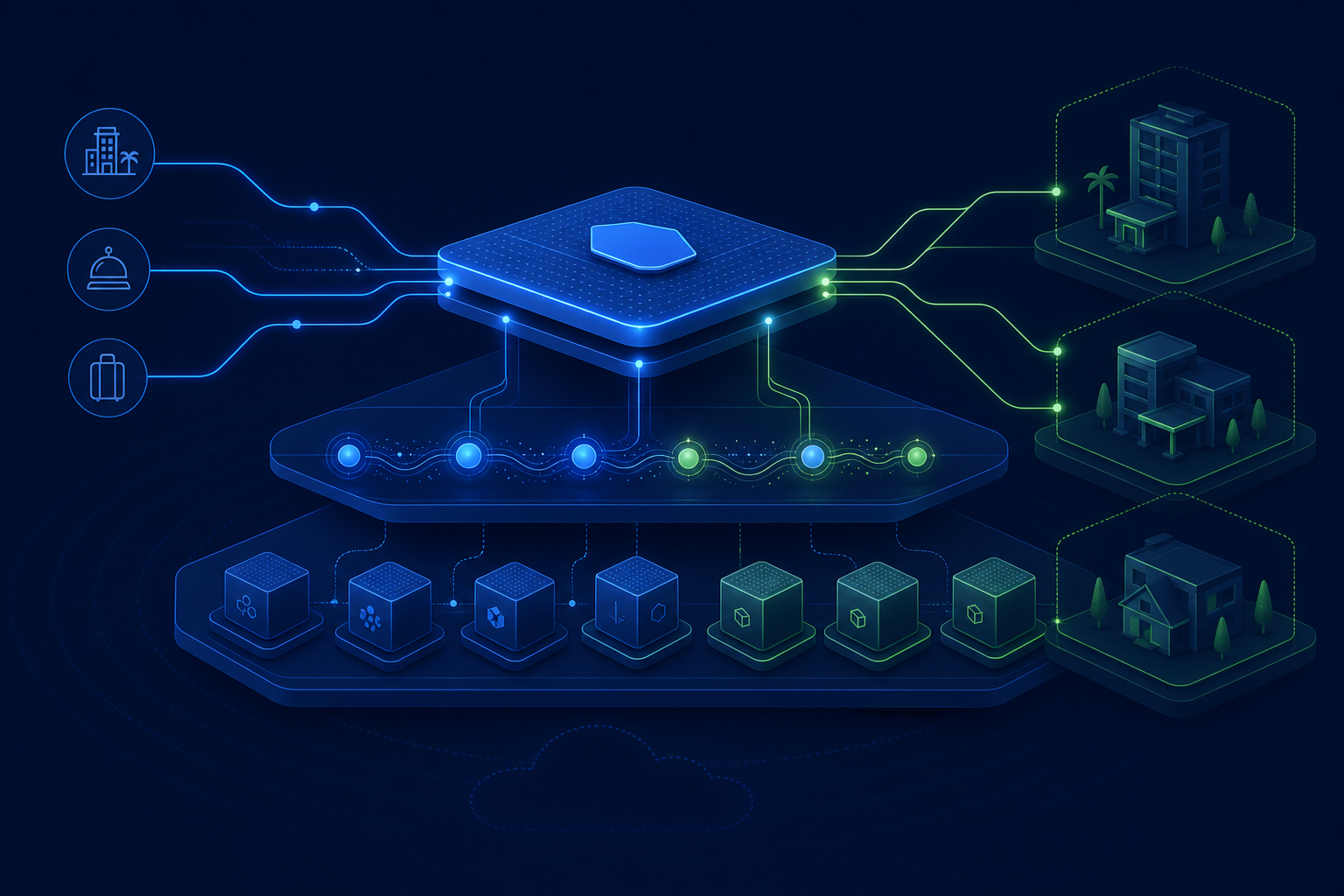
MiseCentral treats hospitality operations as governed business objects—Work, Recipes, Standards, Products, evidence, and recommendations—connected by durable events. External Systems of Record keep their transactions; MiseCentral composes operational intelligence and owned workflows without becoming a POS, PMS, payroll, or accounting replacement by default.
Technical buyers evaluate architecture here; procurement teams pair with Procurement, Trust Center, Integrations, the Enterprise Technology Profile, Inspection Readiness, Operational Evidence, and Food Safety for full diligence.
Evaluation only: No published endpoints, schemas, or authentication implementation on this marketing site.
Product proof
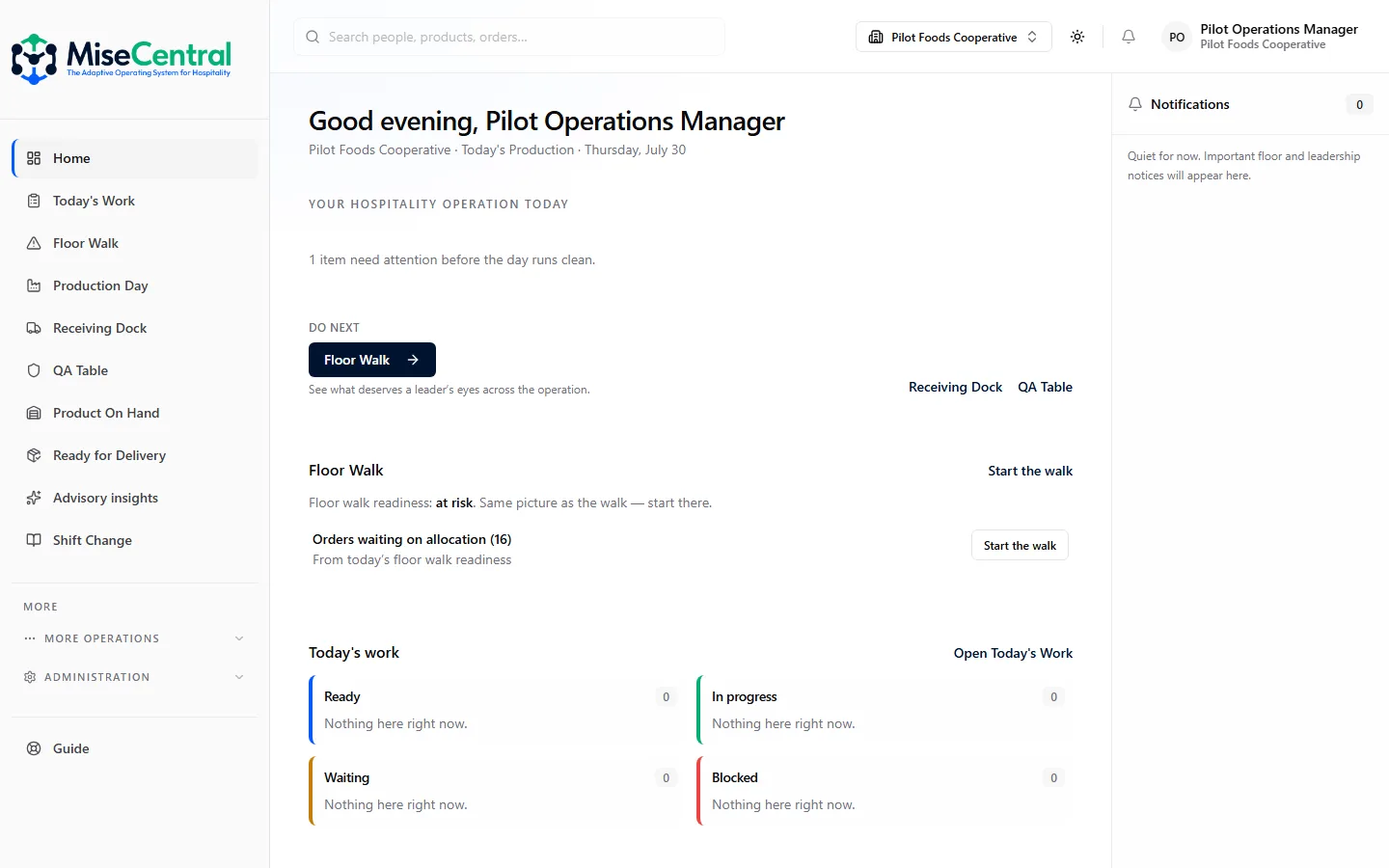
Home, Production Day, and Advisory insights—same platform, role-focused surfaces.
Home
Governed demo preview · current product experience
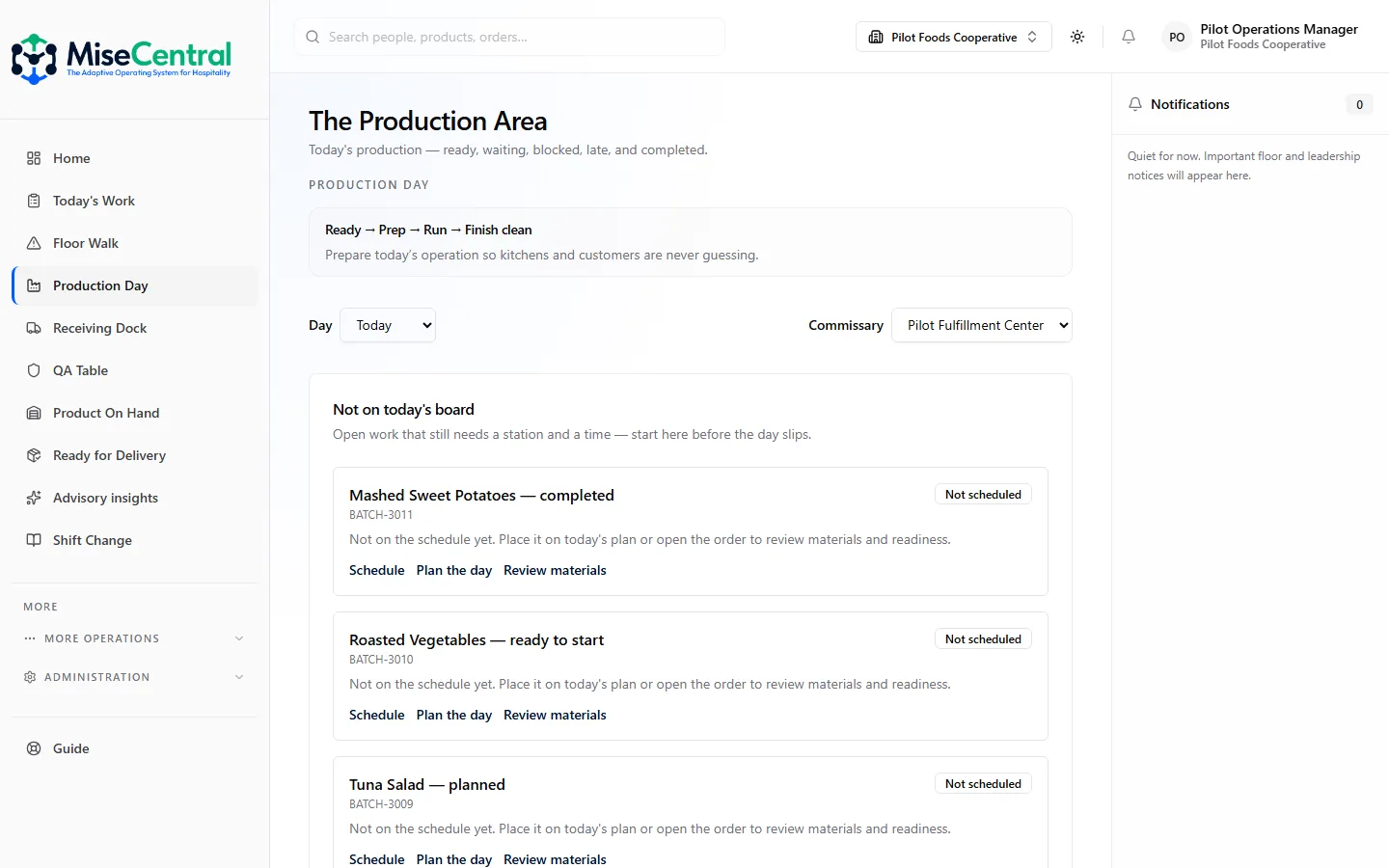
Production Day
Governed demo preview · current product experience
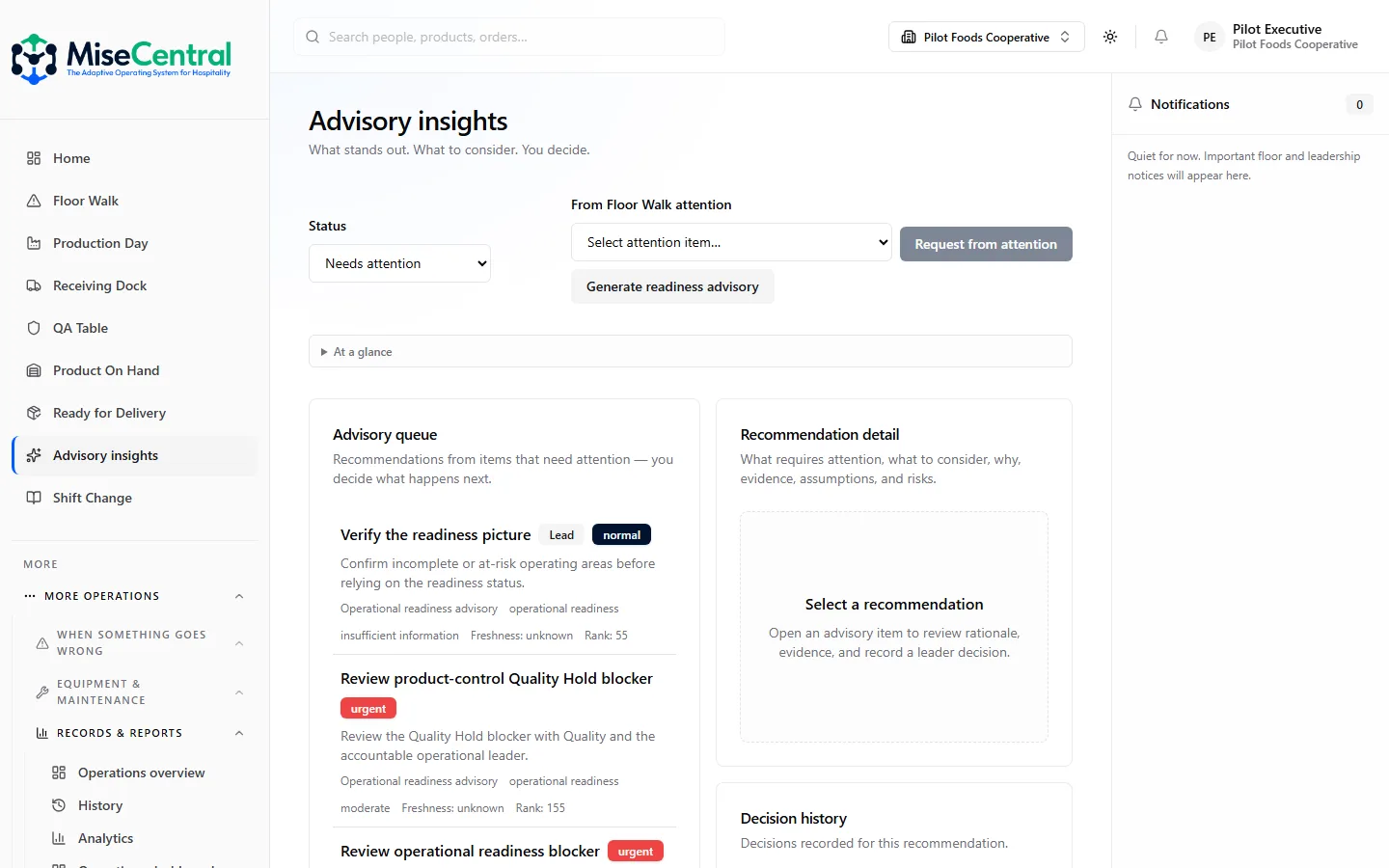
Advisory insights
Governed demo preview · current product experience
Connected Ecosystem
Connect existing Systems of Record and create a governed foundation for advisory recommendations—without implying every connector is live today.
Illustrative categories—no vendor logos or certifications.
Adaptive Operating System
Illustrative results from a connected operational layer.
Platform Architecture
Conceptual architecture diagram—illustrative layers, not infrastructure documentation.
Versioned, tenant-scoped integration surfaces—same contracts consumed by UI and background jobs.
Core capabilities expose integration surfaces first—no shadow APIs behind the UI.
Operational changes propagate as durable business events—subscribers react without polling stale exports.
Every request, event, and background job runs inside your tenant boundary—no cross-customer data paths.
Domain services scale independently—production peaks do not starve inventory or quality workloads.
Long-running sync, reconciliation, and report generation run asynchronously—floor operations stay responsive.
Who changed what, when, and why—governed records carry revision history for enterprise review.
Recipes, formulas, and configuration evolve through explicit versions—not silent overwrites.
Partner connectors, SDKs, and marketplace distribution are architected in—not bolted on after the fact.
API Overview
How MiseCentral exposes capabilities to customer systems. No endpoints, schemas, or authentication flows are published here.
Resource-oriented APIs over HTTPS—create, read, update governed business objects with tenant-scoped credentials.
Push notifications when governed records change—production release, inventory adjustment, quality hold, shipment authorization.
API keys, OAuth-style flows, and enterprise SSO patterns—credentials scoped per tenant, rotatable without platform downtime. Not implemented on this site.
Roadmap Language SDKs and connector templates planned—today, integrations are scoped through solutions teams.
Curated connectors for POS, ERP, WMS, and analytics—see Integrations Center for category evaluation.
Roadmap Public documentation, sandbox environments, and certification programs are planned—not available as self-serve today.
Pair API evaluation with Product Tour for workspace context and Implementation for rollout planning.
Business Objects
Conceptual objects exchanged through APIs and events. Illustrative names only—no published schemas.
Versioned formulations with yields, allergens, and costing lineage.
Authorized batch sheets, floor execution, and release disposition.
On-hand positions, pars, lot identity, and FEFO rotation.
Sites, kitchens, warehouses, and outlets in a governed hierarchy.
Vendor master, performance signals, and approved item catalogs.
Orders sized to velocity with receipt matching and variance flags.
CCP logs, hold-release decisions, and corrective action trails.
Traceability identity from ingredient receipt through shipment.
Governed KPI packages and executive roll-ups from operational truth.
Structured growth checkpoints with evidence-based recommendations.
Pattern-aware insights grounded in tenant data—with rationale, not generic AI answers.
Event Architecture
Conceptual event examples—illustrative names, not published event schemas or topic catalogs.
Published formula version propagates to prep, production, and costing—downstream systems subscribe without manual export.
Floor execution begins against an authorized batch sheet—inventory reservations and labor tasks align automatically.
Batch completion triggers QA checkpoint and material consumption posting—finance sees operational truth, not spreadsheet lag.
Governed release authorizes shipment and ERP posting—hold dispositions carry audit rationale.
Count results reconcile on-hand positions—variance flags trigger review before silent adjustment.
Dock receipt with lot capture closes PO lines—short shipments trigger replenishment, not invisible write-offs.
Hold disposition blocks release and shipment—downstream systems receive hold state, not stale availability.
Release authorization clears holds with documented rationale—audit trail preserved for enterprise review.
Outbound load authorized with lot genealogy—OTIF discipline starts at pick confirmation, not delivery apology.
Structured checkpoint surfaces capability recommendations with evidence—executives evaluate, operators decide.
Extensibility
MiseCentral capabilities enable as your operation matures—recipes before traceability, production before multi-location reporting depth. APIs and events mean new capabilities integrate with existing connectors instead of forcing rip-and-replace programs.
See Capabilities for workspace depth and Pricing for packaging philosophy.
Security Model
Platform security posture for technical evaluation—full diligence resources linked below.
Data in transit over TLS. Sensitive payloads and credentials follow platform encryption standards at rest.
API credentials and user roles scoped to minimum entity access—inventory sync does not inherit quality admin rights.
API calls, webhook deliveries, configuration changes, and operational decisions logged for enterprise review.
Compute, storage, and event streams partitioned per customer—no commingled caches or cross-tenant exports.
Your data stays yours. Recipes, batches, quality records, and operational history remain customer-owned.
Company Brain Architecture
Company Brain observes governed operational data and surfaces patterns with evidence. It does not replace APIs, bypass audit trails, or autonomously change recipes or releases.
Reads governed business objects and events—variance, waste, schedule drift, margin patterns.
Recurring signals across locations and dayparts—grounded in tenant history, not open-internet training data.
Actionable suggestions with rationale—operators approve before any operational change executes.
Structured checkpoints feed capability recommendations when operational evidence supports depth. See Reporting & Executive Business Review.
Customers remain in control. Company Brain assists operators; it does not autonomously execute changes. See Company Brain Center, Product Tour, and what Company Brain observes.
Future Partner Programs
Planned tools for software partners and your IT team. Everything below is on the future roadmap and is not available on this site yet.
A place for technology partners to register and connect their software securely—so your POS, payroll, and inventory tools can share data with MiseCentral the right way.
Planned — not available
A trusted list of connections to systems you already run—registers, accounting, warehouse, payroll, and reporting—reviewed before they go live in your operation.
Planned — not available
Step-by-step setup guides for your IT team or software vendor—how to link systems, sign in safely, and keep production and inventory data flowing correctly.
Planned — not available
Pre-built kits so software partners can plug into MiseCentral faster—with less custom coding and fewer surprises during go-live.
Planned — not available
A safe test kitchen for partners—try connections without touching your live recipes, production runs, or inventory counts.
Planned — not available
Partners go through review for reliability, security, and support—so you know an integration is ready before it touches your floor.
Planned — not available
Forums, working examples, and office hours where integration partners share what works—so your vendors get answers without slowing down your team.
Planned — not available
Today, if you want to connect your tools or talk through options, work with our solutions team through Contact Sales—not a DIY portal on this site.
FAQ
No. This page explains architecture philosophy for technical evaluation. Published API reference, schemas, and authentication flows are on the future roadmap—not on this marketing site.
No endpoints, schemas, or SDKs are published here. Integrations are scoped through solutions teams during customer programs. See Integrations Center.
MiseCentral is designed for API keys, OAuth-style flows, and enterprise SSO—but authentication is not implemented or documented on this public marketing site.
No. Sandbox environments, language SDKs, and partner certification are planned future programs—clearly marked in the Developer Ecosystem section.
Company Brain observes governed business objects and events—it does not bypass APIs or audit trails. Operators remain in control of operational decisions.
Discuss API philosophy, integration patterns, and security posture with your IT and operations teams.
Before capabilities become schedules and execution, MiseCentral understands how operational work is performed—then builds demand that staffing and living-day desks can act on. Leaders stay in command.