Documents
Plans, policies, letters, and governed operational records.

Operational Evidence Center
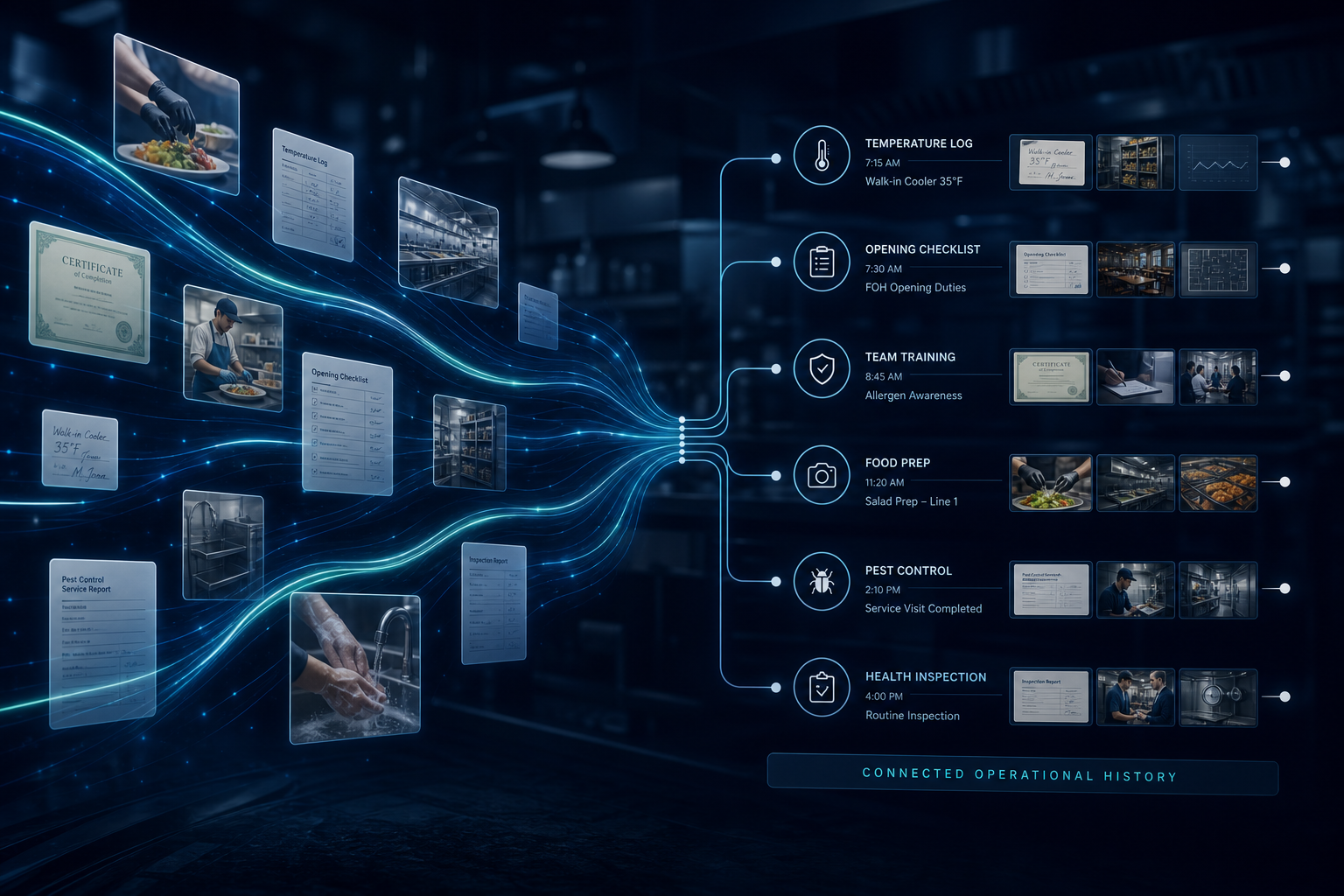
MiseCentral is designed to organize Operational Evidence across your organization—from food safety documentation to equipment photos, inspections, certifications, corrective actions, and operational records. Future capabilities help operators capture evidence once and use it everywhere. This page illustrates platform architecture for evaluation—not a document management system, file storage product, or records management application.
Architecture illustration only. No uploads, document viewer, OCR, or live capture on this marketing site.
What Is Operational Evidence?
Operational Evidence is the foundation for Inspection Readiness, Food Safety, Quality, Maintenance, Business Review, Company Brain, and Traceability. The Adaptive Operating System for Hospitality is designed to organize evidence continuously—instead of forcing operators to search for it later.
Plans, policies, letters, and governed operational records.
Visual proof of conditions, equipment, receiving, and corrective work.
Manager, allergen, food-handler, and related credential evidence.
Temperature, cooling, sanitation, and other operational logs.
Prior findings and responses retained as operational history.
Completion and role-based training evidence with the people who run the operation.
What happened, what changed, and the proof that followed.
Approvals, insurance, and supplier-related operational artifacts.
Calibration, maintenance, and equipment condition evidence.
Verification and quality checks aligned to daily execution.
Connected events over time—not isolated files in a folder.
Evidence Throughout the Business
Operational Evidence is not a side archive. It is designed to be created as work happens across the platform—so records stay tied to the operation that produced them.
Governed recipes and specifications that support auditable production. See Recipe, Formula & Culinary Intelligence.
Batch and run context that becomes part of operational history. See Production & Batch Operations.
Stock and lot context that supports traceability questions.
Condition photos, temperatures, and receiving records at the dock.
Supplier and purchase context linked to what arrived and what was used.
Checks and verification evidence that follow the product.
Lot and movement evidence when origin and disposition matter. See Traceability & Product Genealogy.
Repair photos, work history, and equipment readiness evidence.
Who was on shift when evidence was captured—role and labor context.
Leadership visibility into patterns across evidence and operations. See Reporting & Executive Business Review.
Observations that help operators notice gaps before they become surprises.
Mobile Evidence Capture
Future mobile workflows are designed so operators can capture Operational Evidence where work happens. Future capability. Architecture only. No live upload functionality on this marketing site—no document viewer, OCR, or AI image recognition.
Photograph equipment condition when something fails on the floor.
Document product and packaging condition at receiving.
Capture temperature readings as visual operational evidence.
Photograph sanitizer verification as part of sanitation evidence.
Document cooler and cold-storage condition during checks.
Pair cleaning work with visual before-and-after evidence.
Capture damage at the dock for supplier and receiving follow-up.
Document observations that support pest-control follow-up.
Photograph calibration labels and due-date context on equipment.
Attach credential evidence to people and roles—future capture path.
Photograph shellstock tags as retained operational evidence.
Organize supplier letters with the products and lots they support.
Photograph completed work so corrective history stays complete.
Future capability. No uploads, no camera integration, and no customer data on this page.
Evidence Categories
Categories illustrate how Operational Evidence may be organized by operational purpose—not as a generic file dump. Architecture only; no repository application on this site.
Training completion and role evidence.
Plans, logs, and food safety operational records.
Quality verification and related evidence.
Equipment condition, calibration, and asset context.
Repair history and maintenance-related evidence.
Dock and receiving condition evidence.
Supplier artifacts and approval-related records.
Inventory and lot-linked operational evidence.
Facility condition and location-scoped records.
Cross-cutting compliance-oriented evidence sets.
Policy documents operators need during audits.
Insurance certificates with expiration awareness.
Business and operational licenses.
Product and process specifications.
Visual evidence organized with operational context.
Corrective action packages and follow-up proof.
Internal and external audit-related evidence.
Inspection findings and response history.
Metadata
Every evidence item may carry operational metadata so records can be found by how the business works—not by folder name alone. Future search capability is illustrated here; it is not live on this page.
When the evidence was created or captured.
Time context for shift and event sequencing.
Who captured or is associated with the record.
Which location the evidence belongs to.
Area, station, or zone within the facility.
Operational department ownership context.
Evidence category for repository organization.
Link to inspection profile or visit context.
Lot association for traceability questions.
Supplier association for receiving and approvals.
Equipment association for maintenance and calibration.
Production run linkage for batch-level history.
Corrective action linkage for follow-up proof.
Operator notes that clarify what the evidence shows.
Evidence Timeline
A single event can generate a chain of Operational Evidence—from the first photo through repair, calibration, inspection, and Business Review. Concept illustration only.
Inspection Readiness
When evidence is organized continuously, inspection preparation becomes retrieval—not a scramble. Regulatory names describe frameworks organizations may configure—not MiseCentral certifications or guaranteed outcomes. Explore the full story in the Inspection Readiness Center.
Evidence organization for Florida DBPR-oriented contexts.
Evidence sets that support FDA-oriented food safety questions.
Operational evidence relevant to USDA-oriented contexts.
Evidence organization for SQF-oriented audit preparation.
Evidence organization for BRCGS-oriented readiness.
Customer-required evidence packages illustrated as future workflows.
Internal audit evidence retained as connected operational history.
Company Brain
Company Brain may surface observations about incomplete or aging Operational Evidence. Company Brain recommends. Operators remain responsible.
Illustrative observation when expected visual evidence is absent.
Illustrative observation when credential evidence shows expiration.
Illustrative observation when the same asset keeps generating issues.
Illustrative observation when sanitation evidence appears incomplete.
Illustrative observation when the same gap keeps recurring.
Illustrative observation when required context or attachments are missing.
Company Brain recommends. Operators remain responsible. Observations are not approvals, legal determinations, or guaranteed inspection outcomes. Learn more in Company Brain.
Enterprise Security
Future architecture is designed so Operational Evidence is protected as customer-owned operational truth—not a shared drive. Pair with the Trust Center for enterprise security principles.
Evidence scoped to your organization and facilities.
Storage designed with encryption as a platform principle.
Who accessed or changed evidence remains explainable.
Future versioning so updates do not erase prior context.
Retention designed to align with operational and policy needs.
Customers own their Operational Evidence. MiseCentral organizes it.
Future Workflows
The following items are clearly labeled as roadmap concepts for evaluation. None are available as live functionality on this marketing site.
Roadmap Capture evidence from the floor where work happens.
Roadmap Bring existing records into organized Operational Evidence.
Roadmap Preserve prior versions as policies and records evolve.
Roadmap Assemble related evidence for a topic, visit, or review.
Roadmap Pair with Inspection Readiness for visit-ready packages.
Roadmap Find evidence by metadata and operational context.
Roadmap Narrow by facility, category, date, equipment, or lot.
Roadmap View connected history across an event or asset.
Roadmap Share packages with controlled access—future delivery option.
Roadmap Illustrative concept only—not available and not claimed as live.
Roadmap Associate evidence with items and lots via barcode context.
Roadmap QR-assisted capture and retrieval as a future workflow concept.
Industries
Every industry creates evidence differently. Explore each hub for operational context.
Shift-level logs, training, and inspection evidence for restaurant operations.
Explore Restaurants →Multi-outlet evidence for hotels and hospitality foodservice.
Explore Hospitality →Venue and event evidence that travels with the operation.
Explore Catering →Lot, quality, and production-run evidence for food production.
Explore Production →Prepared foods, suppliers, and retail food evidence patterns.
Explore Retail Food →Receiving, cold-chain, and distribution evidence at scale.
Explore Distribution →FAQ
Operational Evidence is the records, photos, certificates, logs, inspection reports, training records, corrective actions, and related operational history created as the business runs. MiseCentral is designed to organize that evidence continuously across the Adaptive Operating System for Hospitality—not as a standalone document management system.
Photo capture and upload are planned future capabilities illustrated on this page. This marketing site does not accept uploads, store customer photos, or provide a document viewer.
Mobile Evidence Capture is a future capability concept—architecture only on this page. The intent is for operators to capture evidence where work happens and reuse it across Inspection Readiness, Quality, Maintenance, and related workflows.
Customers own their Operational Evidence. Future architecture is designed around tenant isolation, encrypted storage, audit history, and evidence ownership. See Enterprise Administration and Trust Center. See the Trust Center.
Yes—by design. Organized Operational Evidence is the foundation for the Inspection Readiness Center, including planned inspection packages. This does not replace inspectors or guarantee inspection outcomes.
Future metadata design includes lot association so evidence can support Traceability questions. Architecture illustration only on this page.
Yes—by design. Equipment association supports maintenance, calibration, and condition history across an Evidence Timeline.
Retention policies are part of the future enterprise architecture concept. Retention should align with your operational and policy needs; specifics are confirmed during sales and implementation—not from this marketing page.
No. Company Brain recommends. Operators remain responsible. Observations about missing or incomplete evidence are not approvals, legal advice, or compliance determinations.
Talk with sales about continuous evidence organization across Inspection Readiness, Food Safety, Maintenance, Training, Labor Planning, Purchasing, Quality, Traceability, Production Operations, Platform, Trust Center, Technology Profile, Implementation, ROI, Pricing, Resources, and Support.