Role coverage
Operations succeed when critical roles are covered—not when a roster simply looks full.

Labor Planning & Workforce Operations Center
MiseCentral is designed to connect production demand, role readiness, department coverage, training competency, food safety responsibilities, and workforce context inside one Adaptive Operating System for Hospitality. This is an enterprise evaluation page—not payroll software, not HRIS, not a time-clock product, and not employee scheduling software.
Illustrative capability only. Labor planning workflows shown are architectural concepts and future platform capabilities. MiseCentral does not replace payroll, HRIS, time-clock, or employee scheduling systems.
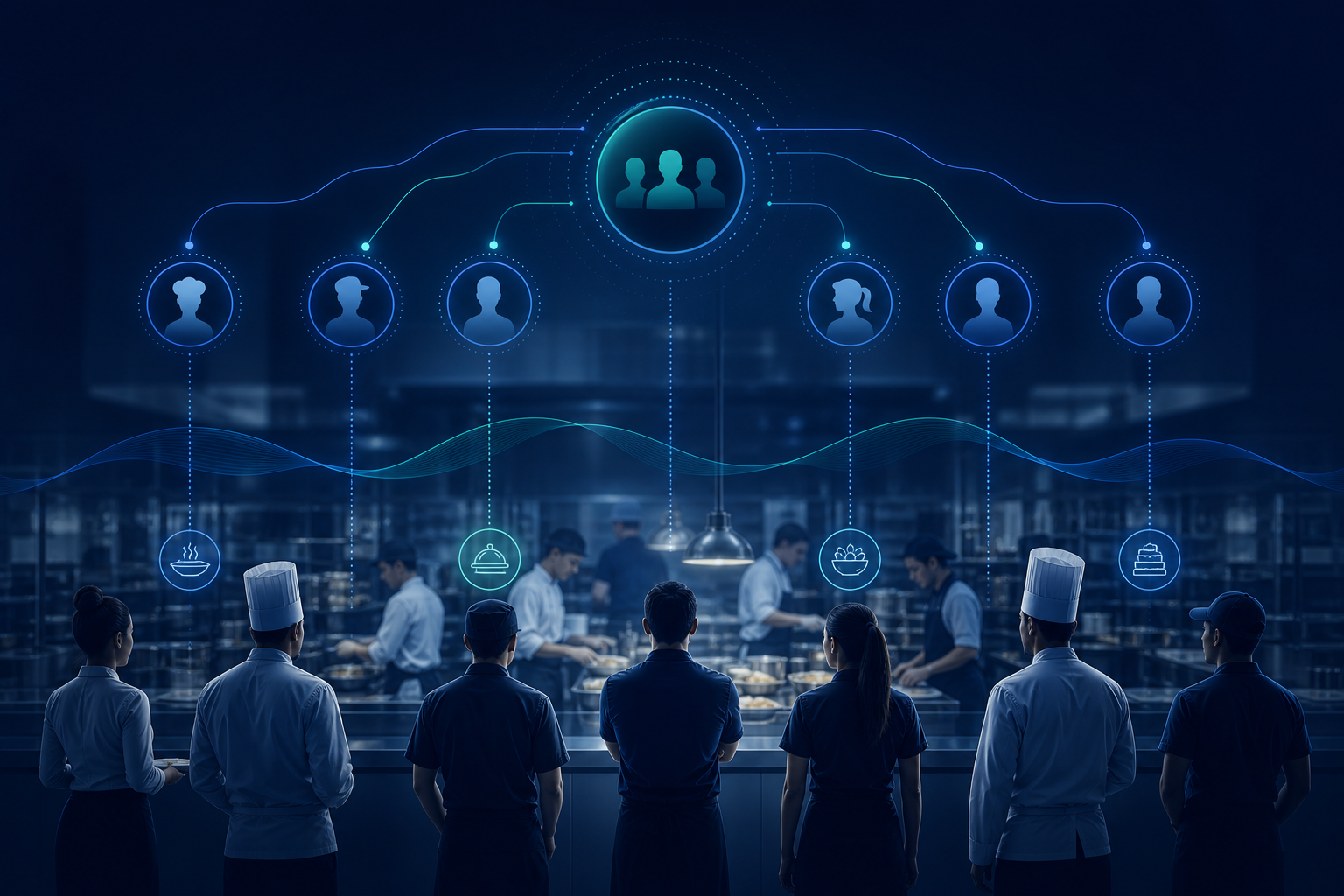
Why Labor Planning Matters
Labor planning is operational context: whether the right qualified people are ready for the work. It is not payroll processing, timekeeping, or building the employee schedule.
Operations succeed when critical roles are covered—not when a roster simply looks full.
Production and service plans are incomplete without understanding available, qualified labor context.
Food safety tasks depend on people who are trained and qualified. See Food Safety.
Competency determines who can safely own a role. See Training & Workforce Competency.
Equipment care and sanitation work require people assigned and ready—not assumed. See Maintenance.
Managers need visibility into capability and qualifications—not just how many people are listed.
Labor planning here means readiness for the work—not calculating pay, taxes, or benefits.
Workforce Operations Framework
MiseCentral is designed to understand whether the operation has the right people ready for the work, without becoming the system that pays them, clocks them, or publishes their schedule. Architecture only.
Visibility into whether required roles are covered for the plan ahead.
Department-level readiness across kitchen, production, service, and support.
Readiness context for a shift—capability and qualifications, not a live schedule editor.
Labor context aligned to production and service demand signals.
Whether sanitation work has people ready to own it.
Assignment context for food safety responsibilities that require qualified people.
Coverage awareness for maintenance and equipment-related work.
Who can cover adjacent roles when primary coverage is thin.
Rules that certain tasks require specific qualifications—architecture intent.
Escalation paths when coverage or qualification gaps appear.
Labor Planning Lifecycle
From demand signal through Business Review, labor context stays connected to how the operation actually runs. Concept illustration only—not live forecasting or scheduling.
Role Coverage & Readiness
Future architecture connects role requirements to qualified people, certifications, and training status. Deepen the competency story in Training & Workforce Competency. No live scheduling or assignment engine on this site.
What each role needs to be ready for the plan ahead.
Who meets the qualifications for a given role or task.
Credential context that affects who can cover food safety or equipment roles.
Whether required training is complete for the people in scope.
Skill depth across a department—not just names on a roster.
Whether food safety responsibilities have qualified coverage.
Who is competent to operate critical equipment safely.
Clear ownership for operational tasks that cannot be left ambiguous.
Who managers escalate to when primary coverage is missing.
System Integrations
MiseCentral is designed to integrate with workforce systems—not replace them. During implementation, customer systems are identified through the Enterprise Technology Profile. The connector roadmap may include systems commonly found in hospitality and food operations. No live integrations are implied. See also Integrations.
Illustrative payroll / HR context. Designed to integrate with—not replace—ADP as a system of record.
Illustrative payroll context. Connector roadmap may include Paychex; feasibility confirmed in implementation.
Illustrative workforce platform context. Not a claim of a live UKG connector.
Illustrative HCM context for enterprise organizations. Architecture evaluation only.
Illustrative scheduling context. Scheduling systems remain systems of record for published schedules.
Illustrative scheduling context. Connector roadmap may include HotSchedules—not live here.
Illustrative workforce scheduling context for evaluation conversations.
Illustrative scheduling / time context. Time clocks remain outside MiseCentral.
Illustrative scheduling context. MiseCentral does not publish employee schedules.
Vendor names illustrate systems commonly found in hospitality—not a marketplace of live connectors. Technology Profile · Integrations
Operational Evidence
Labor Planning & Workforce Operations depends on the Operational Evidence Center. Future organization of the records below—architecture only.
Evidence that role readiness was reviewed for a plan or shift context.
Training and competency evidence that informs who can cover a role.
Evidence that assigned operational tasks were completed.
Records showing sanitation work had coverage and ownership.
Assignment evidence for food safety responsibilities.
Qualification context retained with people and roles.
Notes when coverage gaps required manager escalation.
Evidence from plan-vs-actual labor and readiness reviews.
Company Brain
Company Brain may eventually surface labor and readiness observations. Company Brain recommends. Managers remain responsible. No autonomous personnel decisions. No payroll decisions.
Illustrative observation when coverage appears insufficient before a run or service.
Illustrative observation when the same roles keep coming up short.
Illustrative observation when skill gaps keep limiting coverage options.
Illustrative observation when food safety work lacks qualified people.
Illustrative observation when production or service plans outpace readiness context.
Illustrative observation when coverage depends on a small set of qualified people.
Illustrative observation when variance suggests training or cross-training needs.
Illustrative observation about overtime pressure patterns—not a payroll calculation.
Company Brain recommends. Managers remain responsible. Observations are not hiring, firing, scheduling, or payroll decisions. Learn more in Company Brain.
Enterprise Governance
Workforce operations governance is designed for explainable access, privacy, and source-of-truth clarity. Pair with Trust Center, Platform, and Technology Profile.
Access to labor and readiness context scoped by role and facility.
Managers see coverage and readiness for the areas they own.
Who reviewed or changed labor context remains explainable.
Durable history of readiness and coverage reviews over time.
Workforce context scoped to your organization and facilities.
Privacy-aware design for people-related operational context.
Managers remain accountable for coverage decisions; the platform organizes context.
Connectors governed through the Enterprise Technology Profile.
Payroll, HR, scheduling, and time clocks remain systems of record where appropriate.
Future Roadmap
The following items are clearly labeled as future capabilities for evaluation. Nothing below is implied as already implemented—including forecasting, live scheduling, or notifications.
Roadmap Align labor context to demand signals—not a live forecasting engine here.
Roadmap Connect to scheduling systems of record via governed connectors.
Roadmap Import relevant payroll context—payroll remains the system of record.
Roadmap Leadership visibility into coverage—not live on this site.
Roadmap Track food safety assignments that require qualified people.
Roadmap Rules that certain tasks require specific qualifications.
Roadmap Maps of who can cover adjacent roles.
Roadmap Alerts about skill gaps—not live notifications here.
Roadmap Review readiness before a shift—architecture only.
Roadmap Reports on department coverage patterns over time.
Roadmap Labor and readiness insights in Business Review.
FAQ
No. MiseCentral does not replace payroll. Payroll systems remain systems of record. MiseCentral is designed to organize operational labor context—role readiness and coverage—not to calculate pay.
No. MiseCentral does not replace employee scheduling software. Scheduling systems remain systems of record for published schedules. MiseCentral focuses on operational readiness and coverage context.
No. MiseCentral is not a time-clock product. Timekeeping remains with the customer’s time-clock or workforce system. Any future context import would be governed through the Enterprise Technology Profile.
MiseCentral is designed to integrate with payroll and HR systems commonly found in hospitality. The connector roadmap may include ADP and Paychex. Feasibility and scope are confirmed during sales and implementation—not from a public live-connector claim. See Technology Profile and Integrations.
Scheduling system integrations are part of the illustrative connector roadmap. 7shifts, HotSchedules, and similar platforms may be identified during the Technology Interview. No live scheduling connectors are implied on this page.
Yes—by design. Role coverage and readiness architecture connects role requirements to qualified people, certifications, and training status. See Training & Workforce Competency. Live qualification views are not available on this marketing site.
Yes—by design. The labor planning lifecycle starts with demand signals and production or service plans, then reviews role requirements and qualified coverage. Architecture illustration only—not live forecasting.
Yes—by design. Qualified-person requirements and food safety assignment tracking are future architecture concepts that connect Labor Planning to Food Safety and Training.
Company Brain may eventually surface observations about coverage shortages, skill gaps, and readiness risks. Company Brain recommends. Managers remain responsible. No autonomous personnel or payroll decisions.
Training determines who is ready. Labor Planning uses that competency context to review role coverage against operational demand. Together they support readiness without becoming an LMS, HRIS, or scheduling product. See Training & Workforce Competency.
Talk with sales about workforce operations architecture across Training & Workforce Competency, Technology Profile, Integrations, Platform, Implementation, Food Safety, Purchasing, Quality, Traceability, Production Operations, Operational Evidence, Trust Center, ROI, Pricing, and Support.
Static hour estimates miss equipment waits, two-person transfers, and verification. Work Intelligence builds staffing from how work is actually performed—then leaders approve recommendations.