
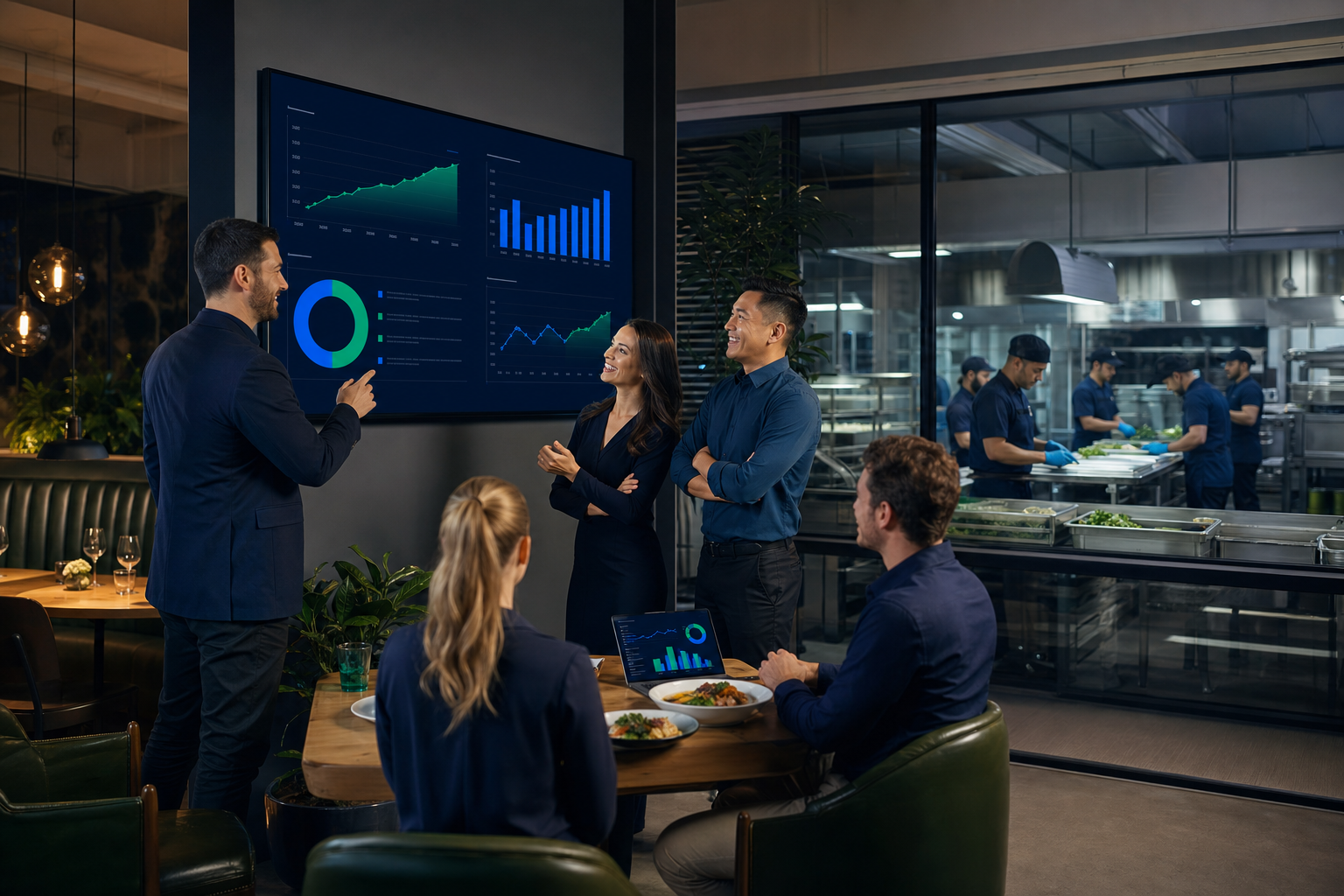
Note: This is a representative operational scenario based on common patterns observed across hospitality and food production. It does not depict a specific named customer. Verified customer stories will use the same URL and page structure when published.
Challenge
A full-service hotel operated seven F&B outlets—banquet kitchen, three restaurants, pool bar, room service, and employee dining—each with its own prep rhythm and partial recipe library. Banquet events routinely collided with outlet production for equipment and skilled labor. Procurement placed orders by outlet rather than property, duplicating deliveries and fragmenting cost visibility.
The director of F&B spent Mondays consolidating spreadsheets for executive committee instead of resolving the conflicts that generated the variance.
Goals
- Reduce same-day banquet and outlet production conflicts by thirty percent
- Align shared base components on identical published recipe versions across outlets
- Consolidate procurement visibility at property level without removing outlet accountability
- Cut weekly executive review preparation to under three hours
Operational approach
Implementation began with outlet mapping: shared components, equipment constraints, and labor pools documented in one operational calendar. Banquet production integrated into the same schedule layer as outlet prep, with conflict rules escalated forty-eight hours before event service.
A corporate recipe library covered bases and sauces; outlets retained governed local variants for presentation and garnish. Company Brain observations highlighted recurring collision patterns—Friday banquet load versus Sunday brunch prep—that manual review had missed.
Platform capabilities used
The transformation succeeded when these workflows lived on one adaptive platform—connected capabilities that adapt to how the operation runs, rather than disconnected tools that force teams to conform.
- Catering — BEO-driven production and banquet schedule integration
- Production — cross-outlet prep planning and shared component batches
- Scheduling — equipment and labor conflict detection
- Company Brain — property-level operational intelligence and review packages
Outcomes
Banquet prep conflicts dropped forty percent within sixteen weeks. Cross-outlet recipe alignment on shared bases reached ninety-one percent. Weekly executive review preparation fell to two hours using live property data.
Procurement consolidated deliveries where par levels allowed, reducing receiving labor without centralizing outlet ordering authority.
Lessons learned
- Hotel F&B fails on collision detection, not recipe quality—one calendar beats seven siloed prep lists
- Shared components deserve stricter governance than outlet-specific finishing steps
- Executive reporting should be a byproduct of operations, not a Monday reconstruction project
- Preserve outlet accountability while consolidating visibility—property-level view does not mean corporate micromanagement