Organizations
The tenant root—every governed record belongs to exactly one organization.

Enterprise Administration & Governance
MiseCentral is designed to govern enterprise operations through secure administration, organizational structure, role governance, tenant isolation, and auditability—so organizations scale confidently on one Adaptive Operating System. This page explains how enterprise governance works—not a live admin console.
Illustrative governance concepts. No live admin workflows on this marketing site.
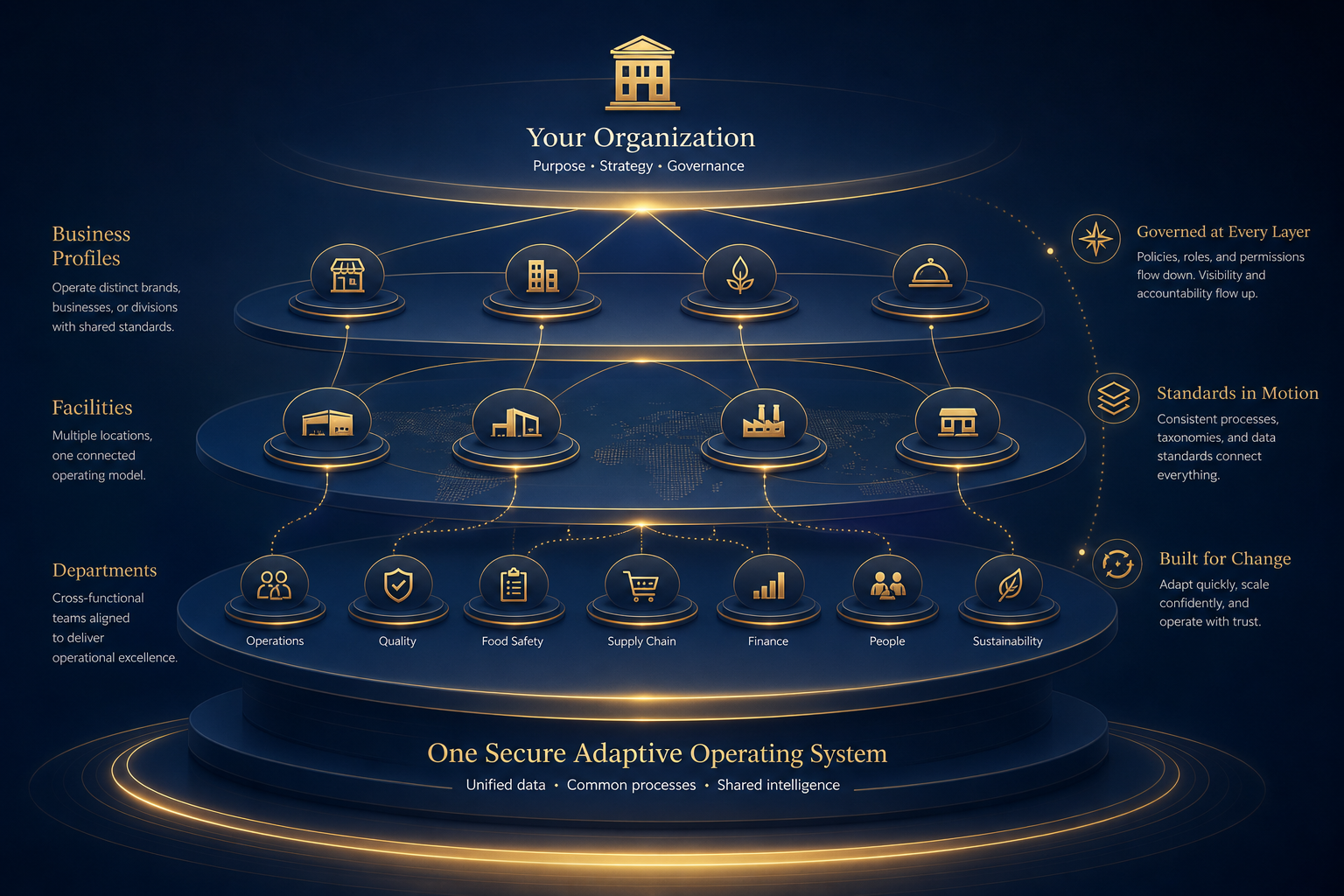
Enterprise Administration Philosophy
Enterprise administration is about explainable governance—not simply user accounts. Administration connects how organizations, facilities, roles, and standards work together across the Adaptive Operating System.
The tenant root—every governed record belongs to exactly one organization.
How the platform adapts language, workspaces, and capability context to your operation type.
Restaurants, plants, hotels, commissaries, and warehouses as governed operational scope.
Roadmap Regional guidance within corporate governance for multi-location networks.
Roadmap Kitchen, production, quality, and receiving as scoped operational responsibility.
People assigned to organizations with governed access—not a standalone directory product.
Capability-driven responsibilities—owner, administrator, operations manager, quality, and more.
Role-based access scoped to least privilege within the organization boundary.
Tenant isolation, audit history, and security governance. See Trust Center.
Proof that grounds governance and review. See Operational Evidence.
Structured leadership conversations informed by governed operations. See Business Review.
Corporate standards and network governance across locations. See Multi-Location.
Enterprise governance creates one secure operational foundation while allowing organizations to scale confidently.
Governance Lifecycle
How governance is designed to grow with your organization—not a live workflow on this site.
Enterprise Governance Framework
Enterprise governance building blocks—evaluation concepts, not a feature checklist.
Tenant root boundary—every record scoped to one organization.
Adaptive operation context—terminology, workspaces, and capability shaping.
Governed operational locations within the organization.
Roadmap Regional governance within multi-location networks.
Roadmap Scoped operational units within facilities.
Organizational membership with governed access assignment.
Capability-driven responsibilities—not page-driven permissions.
Least-privilege access scoped to organization and facility context.
Roadmap Enterprise identity context within organization boundaries.
Roadmap Governed sign-in architecture—not exposed on this marketing site.
Roadmap SSO readiness for enterprise identity providers.
Explainable record of administrative and operational changes.
Roadmap Governed organization preferences—not a public settings page.
Roadmap Organization-level compliance posture configuration.
Security policies, reviews, and tenant isolation posture. See Trust Center.
The governed foundation every capability builds upon—not a back-office console.
Organization Structure
PLATFORM-01 is designed to support organizations that grow from a single facility to national networks—without changing the operational language teams use every day.
Roadmap Corporate root with governed subsidiary relationships.
Roadmap Legally distinct entities under shared governance standards.
Roadmap Brand-level standards with facility-specific execution context.
Roadmap Operating concepts within a brand portfolio—fast casual, fine dining, commissary.
Governed operational locations—each with scoped evidence and permissions.
Roadmap Kitchen, production, quality, and receiving as operational scope.
Corporate standards propagated across the network. See Multi-Location.
Roadmap Regional or facility administrators within corporate policy.
Roadmap Organization-wide governance rules applied consistently across capabilities.
Governance scales without changing the operational language—teams still work in recipes, production, quality, and evidence.
Security & Administrative Controls
Security and administrative controls are designed for enterprise evaluation—not all items below are currently implemented. See Trust Center and Procurement for procurement-ready posture.
Capability-driven roles scoped to organization and facility context.
Access limited to operational responsibility—not broad admin rights by default.
No cross-customer data paths—every request scoped to organization boundary.
Administrative and operational changes designed for explainable history.
Roadmap Organization-level credential policy configuration.
Roadmap Multi-factor authentication architecture for enterprise accounts.
Roadmap Enterprise identity provider integration posture. See Technology Profile.
Roadmap Google Workspace, Microsoft Entra ID, Okta—directory context, not replacement.
Periodic governance review as part of enterprise evaluation and procurement.
Roadmap Governed approval for administrative changes and operational releases.
MiseCentral is not an identity provider replacement. Enterprise identity integrates within governed organization boundaries.
Company Brain Governance Relationship
Company Brain is designed to provide recommendations only to users authorized to view them. Adaptive intelligence respects organization boundaries, permissions, facility scope, and operational responsibility.
Observations scoped to tenant context—never cross-customer.
Recommendations visible only to roles authorized to see them.
Location-specific observations respect facility governance context.
Recommendations aligned to role accountability—not autonomous override.
Company Brain never approves, releases, purchases, or changes records autonomously.
Recommendations prepared with evidence—operators decide whether to act.
Operational Evidence & Audit History
Administrative governance connects to Operational Evidence—so changes remain explainable, auditable, and customer-owned.
Who changed what, when, and under which role—designed for explainability.
Roadmap Assignment and revocation recorded in governance history.
Roadmap User-to-facility scope changes documented.
Roadmap Structural changes to organization hierarchy recorded.
Human approval history associated with governed operational changes.
Business Review cycles and follow-up outcomes. See Business Review.
Roadmap Training and policy acceptance tied to role governance.
Enterprise Examples
Illustrative examples only—architecture intent, not customer-specific implementations.
One organization, one facility, owner and kitchen manager roles—recipes and inventory governed from day one.
Multiple facilities under one organization—shared recipe standards with local execution context.
Property-level facilities with banquet, outlet, and commissary scope—executive review across the portfolio.
Central production facilities serving satellite locations—traceability and quality governed network-wide.
Plant facilities with production, quality, and traceability roles—batch release remains human accountability.
Hundreds of facilities with corporate standards and regional delegation—fair comparison during Business Review.
Warehouse and cross-dock facilities with receiving, inventory, and traceability governance across the network.
FAQ
Each organization is the tenant root. Operational records, evidence, and governance context are scoped to exactly one organization—no cross-customer data paths. See Trust Center for tenant isolation posture.
Customers own their operational data. MiseCentral governs access within organization boundaries—customer data ownership is a core governance principle. See Privacy and Procurement.
Roadmap Enterprise architecture is designed to support governed membership across organizations where business relationships require it—always with explicit scope, never implicit commingling.
Yes—by design. Company Brain provides recommendations only to users authorized to view them. It respects organization boundaries, facility scope, and role permissions. See Company Brain.
Every request, record, and background process is scoped to the organization boundary. Compute, storage, and operational context are partitioned per customer. See Platform and Trust Center.
Roadmap SSO readiness is part of enterprise architecture—designed to integrate with identity providers such as Google Workspace, Microsoft Entra ID, and Okta. Not available as self-serve on this marketing site. See Technology Profile and Integrations.
Roadmap Multi-factor authentication is part of enterprise security architecture—not claimed as currently available on this marketing site.
Roadmap Delegated administration—regional or facility administrators operating within corporate policy—is part of the enterprise governance design for multi-location networks. See Multi-Location.
Administrative and operational changes are designed for explainable audit history—who changed what, when, and under which role. Connected to Operational Evidence as the proof foundation.
Corporate standards propagate through network governance—facilities execute within governed scope while retaining local operational context. See Multi-Location & Network Governance and Implementation.
Talk with sales about organizations, locations, roles, permissions, and how Company Brain stays inside your governance rules.